A pnpm and Turborepo monorepo that takes a source clip and carries it to a published short.
The system is 541 files across eight packages: a NestJS API with health probes and an OpenAPI
surface, a BullMQ worker running one processor per pipeline stage, a Next.js review dashboard,
a Remotion renderer, a source-adapter registry, a shared core package holding the domain types,
a Zod environment contract and nine scoring signal extractors, and an MCP server exposing
score_candidate, dedupe_check and select_daily_winner as tools. Data lives in Supabase Postgres
behind a Drizzle schema with row-level security on every table, asserted in CI alongside a
quality gate and a migration format guard.The pipeline runs in twelve stages: ingest, score, select, script, voice, align, visual, render,
human review, publish, measure, feedback. The review gate sits between render and publish and is
not optional — nothing reaches an audience without a person clearing it first.Implementation was agent-assisted. What is mine is the architecture and the direction: where each
stage boundary sits, why the review gate is a gate rather than a report, row-level security as a
default rather than an afterthought, the Zod environment contract, and the decision to expose
scoring and selection as MCP tools instead of burying them inside the worker.TODO(razvan): decide how much of the paragraph above you want on the page. It is all established
in OWNERSHIP.md, but it is dense. One or two paragraphs reads better than three.
Third Party Integrations
TODO(razvan): one H3 per service, each with a short bulleted list of what it does here and why it
was chosen. The services below are the ones OWNERSHIP.md establishes are in the repo. Nothing has
been written under them because the specifics — models, plans, quotas, failure modes — are not
measured anywhere and must not be guessed.
Supabase
TODO(razvan): what Postgres holds, how RLS policies are shaped, how migrations are applied.
Redis and BullMQ
TODO(razvan): queue topology, per-stage retry and failure boundaries, what a dead-lettered job looks like.
Remotion
TODO(razvan): what the composition renders, where it runs, how long a render takes.
Model Context Protocol
TODO(razvan): what score_candidate, dedupe_check and select_daily_winner expose, and who calls them.
TODO(razvan): remaining services
TODO(razvan): the voice, alignment and publishing stages each call something. Name them once you
are ready to name them.
Challenges and Learnings
TODO(razvan): one H3 per challenge, prose underneath. Aim for three or four. The strongest ones
here are architectural, which is exactly where your ownership is strongest — pick problems where
the interesting part is the decision, not the code.
TODO(razvan): why twelve stages and not four
TODO(razvan): the stage boundaries are the part of this project you can defend line by line. Write
down why each cut sits where it does — what retries independently, what a failure at that point
costs, what a human can usefully inspect there.
TODO(razvan): the review gate as a gate
TODO(razvan): what happens to a run that stalls at review, and what that constraint cost you
elsewhere in the design.
TODO(razvan): row-level security on every table
TODO(razvan): what the CI assertion actually checks, and what it caught.
Outcome
TODO(razvan): the reference case studies interleave screenshots with H3 sections here. You have
neither screenshots nor outcome numbers yet.TODO(razvan): do NOT fill this section with invented numbers. Videos published, runs completed,
review pass rate, time from ingest to publish — every one of those would be a real, checkable
figure, and none of them are measured. If no number exists when you come back to this, write the
outcome qualitatively or cut the section. An empty Outcome is survivable; a fabricated one is not.
Related projects
Multi-Brand Content & AI Platform
A multi-domain publishing platform combining server-rendered content, headless CMS workflows, technical SEO and an authenticated streaming AI assistant.
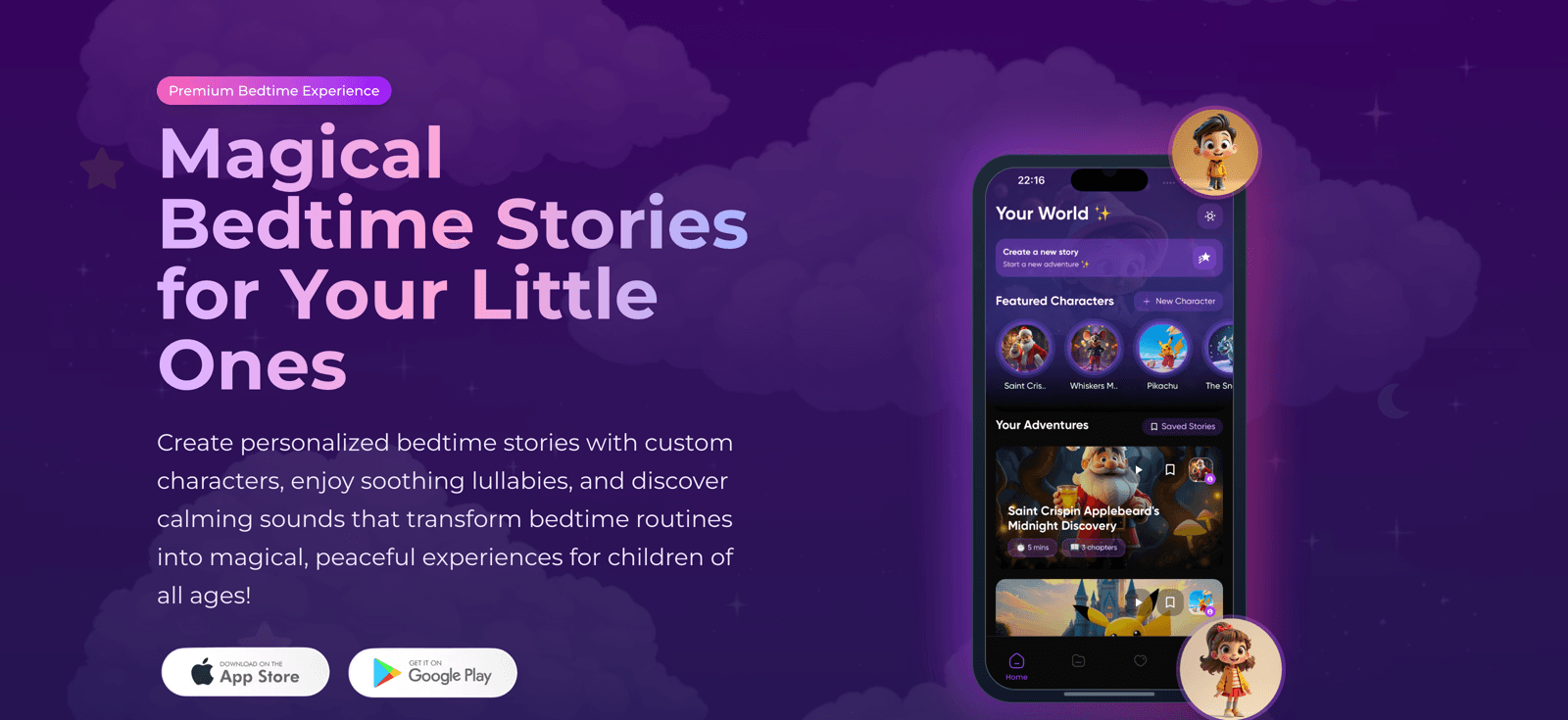
A React Native bedtime-stories product on iOS and Android: parents generate a personalised, illustrated story for their child and have it narrated in one of four voices.